Taxonomies are a kind of knowledge organization system. I had explained this in a prior blog post “Taxonomies as Knowledge Organization Systems.” Since then, I have learned more about “Knowledge Organization” (KO), not just the systems (KOS), through the International Society of Knowledge Organization (ISKO) and its most recent international conference, held August 17-19 in São Paulo, Brazil.
Taxonomies in the Scope of Knowledge Organization
ISKO defines KO in an article in its online ISKO Encyclopedia of Knowledge Organization:
KO is about describing, representing, filing and organizing documents and document representations as well as subjects and concepts both by humans and by computer programs. For these purposes, rules and standards are developed, including classification systems, lists of subject headings, thesauri and other forms of metadata. The organization of knowledge into classification systems and concept systems are core subjects in KO.
Although “taxonomies” are not explicitly named in this brief definition, they definitely are a kind of “concept system,” and taxonomies are mentioned further on in within the long encyclopedia article on KO.
The introductory paragraph on KO in the ISKO encyclopedia entry goes on to explain two main components of knowledge organization:
The two main aspects of KO are (1) knowledge organization processes (KOP) and (2) knowledge organization systems (KOS). Knowledge organization processes are, for example, the processes of cataloging, subject analysis, indexing, tagging and classification by humans or computers. Knowledge organization systems are the selection of concepts with an indication of selected semantic relations. Examples are classification systems, lists of subject headings, thesauri, ontologies and other systems of metadata.
The distinction and relationship between knowledge organization systems (KOSs) and knowledge organization processes (KOPs) was also mentioned in conference presentations I attended.
These two aspects of KO are relevant for taxonomies, too. When designing and creating taxonomies, taxonomists and knowledge managers should also consider the process of applying the taxonomies. The processes, I believe, go beyond merely type of tagging, which could be manual, rules-based auto-tagging, traditional AI methods (machine learning, natural language procession, and entity extraction), LLM-support with RAG or GraphRAG. “Processes” include the workflow and the interactions of people in various roles with the taxonomies. This was not discussed in depth at the conference, but I would like to explore it further in the future.
Research in Support of Knowledge Organization
KO is a field of study and research, especially within the academic discipline of information science, and it is often put into practice by librarians. It is not, however, known as a field or specialty within business or industry, where instead the related fields include information architecture, knowledge management, and semantic modeling or knowledge engineering.
Thus, ISKO members and conference attendees are predominantly academic: professors, researchers, and doctoral students. There were a few other non-academic practitioners at the conference beside myself, including my co-panel speakers Joseph Busch (Taxonomy Strategies) and Marjorie Hlava (Access Innovations). There were also doctoral students considering future employment in industry instead of academia. The conference had an “applied” KO track, but most of the “applied” topics were presented by academic researchers. What was significant was that presentations considered actual KO applications, and thorough research had been done to come up with conclusions, often with quantitative analysis.
This raised the issue for me of the relative lack of research to back up the methods used to implement KO systems and processes in companies and other organizations. Knowledge managers, taxonomists and related consultants follow “best practices” that they have learned from colleagues or managers, but whether these are really the “best” methods for designing and implementing a KOS and KOP is not certain. I believe that adopting certain research methods refined by academic researchers or even partnering with academic researchers may result in better KOSs and KOPs. Fostering more conversation between academia and industry in the area of knowledge organization is also the interest of John Kausch, whom I met at the conference, who is helping to plan a conference and invited me to speak for this purpose at Western University, Ontario, next June.
AI and Ethics in Knowledge Organization
AI was a dominant theme in conference sessions, including the second day’s keynote presented by Prof. Heather Moulaison-Sandy, “KO under Constraint: Equity, Integrity, and Infrastructure in an AI Era” and in the panel “AI and the Future of Research.” Rather than considering AI only in the narrow context of how AI is used to create taxonomies and other KOSs or how KOSs can support AI, a broader approach was taken when considering the research-support objectives of KO.
In the opening the to the Applied KO track, ISKO president Prof. Thiago Henrique Bragato Barros noted that there were 16 papers in the Applied track dealing with AI, and he shared his observation that there was a more positive view of AI in this track (of “Dimension”) of the conference, including papers on AI enhancing KOS.
Even the standards panel on which I spoke was rounded out with the presentation on the multiple ISO standards dealing with AI that are being developed by the committee ISO/IEC JTC 1/SC 42 Artificial Intelligence, given by Prof. Marcia Zeng.
Ethics was another common theme for many presentations, especially considering the potential biases that classification systems may have. The first day’s opening keynote, presented by Prof. Widad Mustafa El Hadi, was titled “Ethics in KO Through the Lens of Epistemologies of Violence.” Although taxonomies may be subject to bias and ethical issues, I believe that is less the case for taxonomies than it has been for classification schemes, which are more rigid in their design.
ISKO and its International Conference
ISKO is a global organization with chapters in various countries or multi-country regions. It was founded in Germany in 1989 with the goal of being an interdisciplinary organization to unite professionals from information science, philosophy, linguistics, and computer science. In addition to the ISKO Encyclopedia of Knowledge Organization, ISKO publishes a scholarly journal called Knowledge Organization and its conference proceedings in Advances in Knowledge Organization.
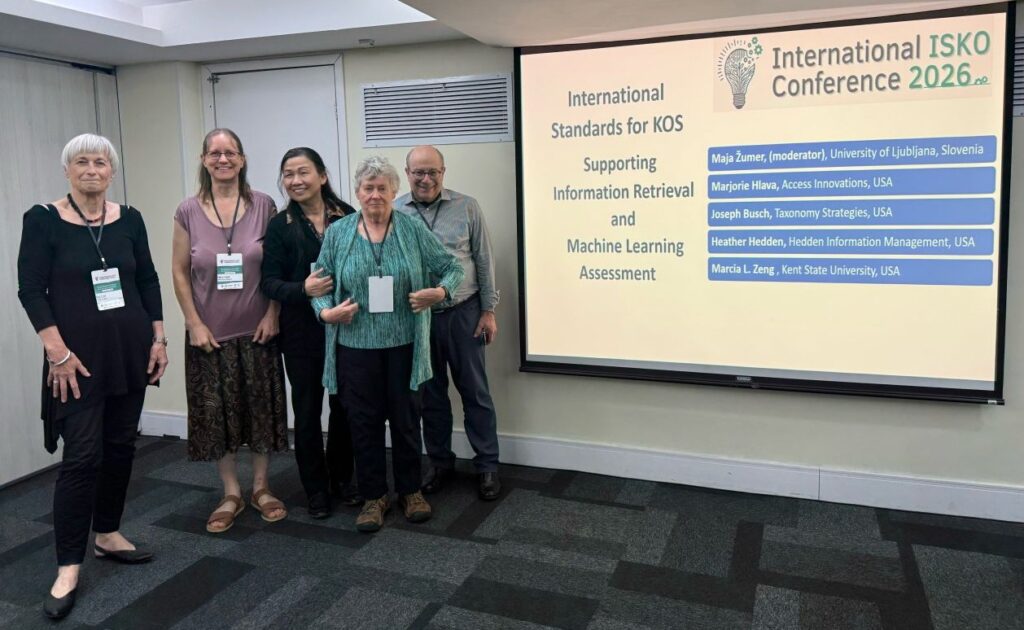
ISKO holds a biennial international conference, while its chapters may meet more frequently or in alternating years. This year’s conference was in São Paulo, Brazil, and the vast majority of the attendees were from Brazil, even though the conference was conducted entirely in English. I presented both a 2.5 hour “Taxonomy Design Workshop” and a presentation on “Thesaurus Standards for Taxonomies” as part of a panel “International Standards for KOS Supporting Information Retrieval and Machine Learning Assessment.”
The next international conference will be held next in Coimbra, Portugal, in 2028.